Cold feet? Not a chance: how Bodø/Glimt put Europe on ice
From Arctic snow to a historic Europa League semi-final, Norway’s unlikely contenders sent Lazio packing and proved that footballing giants can get a frosty reception.
 Andrea Michelini
2 min read
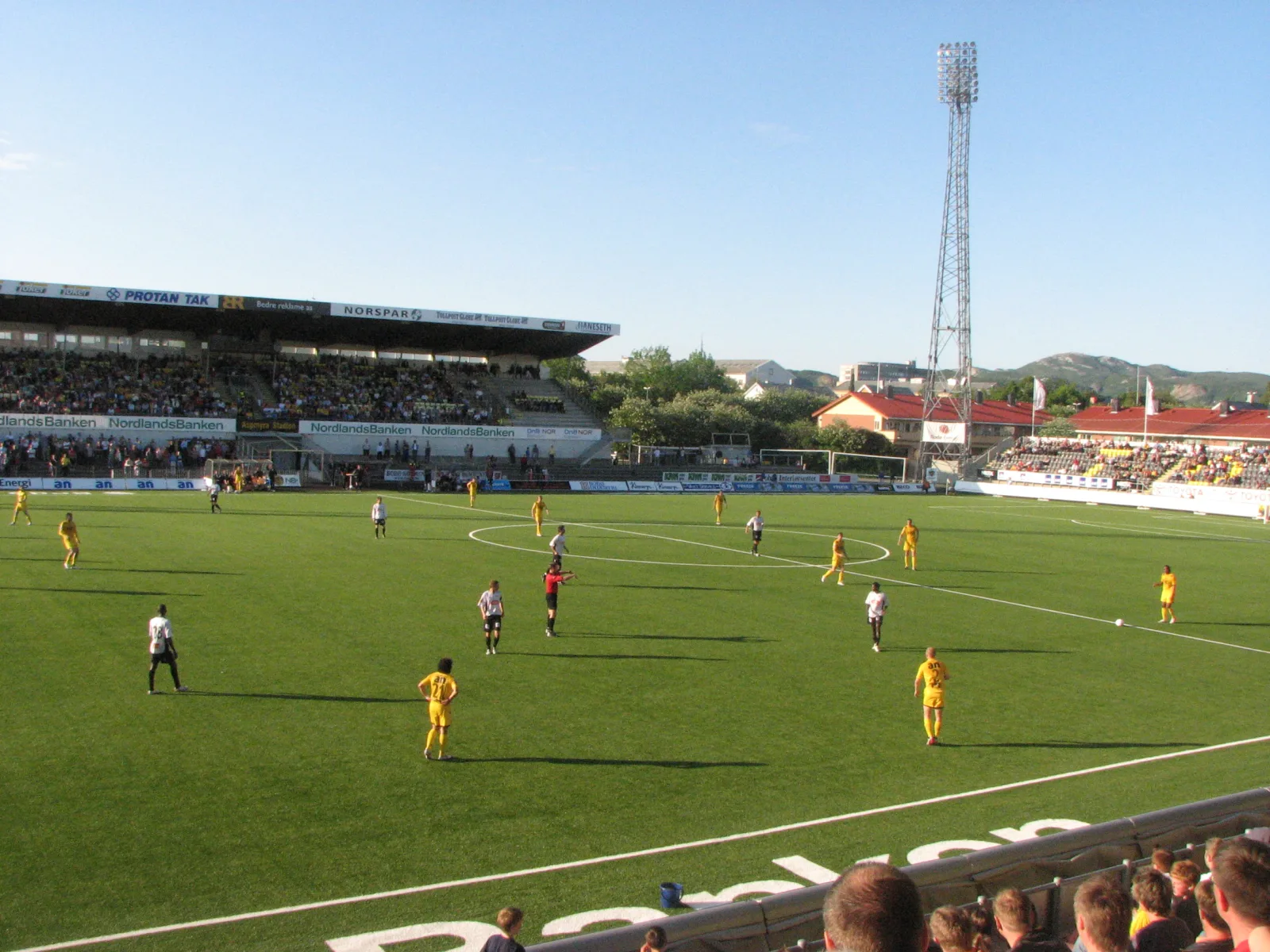
Lars Røed Hansen / Wikimedia Commons, CC BY-SA 2.5 (https://creativecommons.org/licenses/by-sa/2.5/). Archive, June 2007.
European football has plenty of familiar centres of gravity. Bodø, inside the Arctic Circle, is not usually the first place that comes to mind. That is part of what made Bodø/Glimt’s 2025 Europa League run so compelling: opponents had to travel beyond the usual map of footballing prestige and then deal with a very capable team.
The breakthrough arrived against Lazio. After winning the home leg 2–0, the Norwegian side lost 3–1 in Rome but advanced on penalties following a 3–3 aggregate draw. It became the first Norwegian club to reach the semi-finals of a men’s European competition. The achievement is documented in La Voz de Galicia’s account of the historic qualification.
The home leg provided an almost irresistible visual shorthand. Reuters reported snow before the match, freezing conditions and two goals from Ulrik Saltnes. Yet reducing the performance to cold weather misses the more important detail: Bodø/Glimt repeatedly troubled Lazio, whose attacking output was limited.
An unfamiliar climate can inconvenience an opponent. It cannot, by itself, organise a team’s movement, create passing options or decide when to enter the penalty area. The temptation to explain the result through the setting risks overlooking the football that took place within it.
The longer story also resists the idea of a sudden miracle. Kjetil Knutsen joined the coaching staff after relegation and later took charge, with the club winning its first league title in 2020. The 2025 European breakthrough followed a period of development rather than appearing from nowhere.
That suggests a more useful lesson for ambitious smaller clubs than simply dreaming of an upset. Continuity can give a team a shared language: players understand the movements expected around them, recruitment can serve a recognisable approach and setbacks need not trigger a complete reinvention.
This is an interpretation of the club’s trajectory, not a formula guaranteed to work elsewhere. Money still matters, as do player quality, recruitment decisions and individual performances under pressure. The appeal of Bodø/Glimt is not that it abolished football’s financial inequalities, but that it made those inequalities an incomplete explanation of what was possible.
The run ended against Tottenham, who won 5–1 on aggregate, as recorded in UEFA’s second-leg report. Keeping that ending in the story is important. A semi-final defeat does not invalidate the achievement, and the achievement does not require pretending that every obstacle was overcome.
What remains is a striking change of perspective. For a period in the spring of 2025, a club from northern Norway was not a picturesque footnote to somebody else’s European campaign. It was the opponent deciding who could continue.
That is the enduring charm of Bodø/Glimt’s run: the journey looked unusual on a map, but the right to be there had been earned on the pitch.
Andrea Michelini
Writer
 Cold Trafford: can a new stadium rekindle Man Utd's broken projects?

No comments yet — be the first.