Less horsepower, more horseplay: MotoGP hits the reset button
Smaller engines, fewer gadgets and a bold promise of closer racing. MotoGP’s 2027 revolution could prove that slowing the bikes down makes the action hotter.
 Andrea Michelini
2 min read
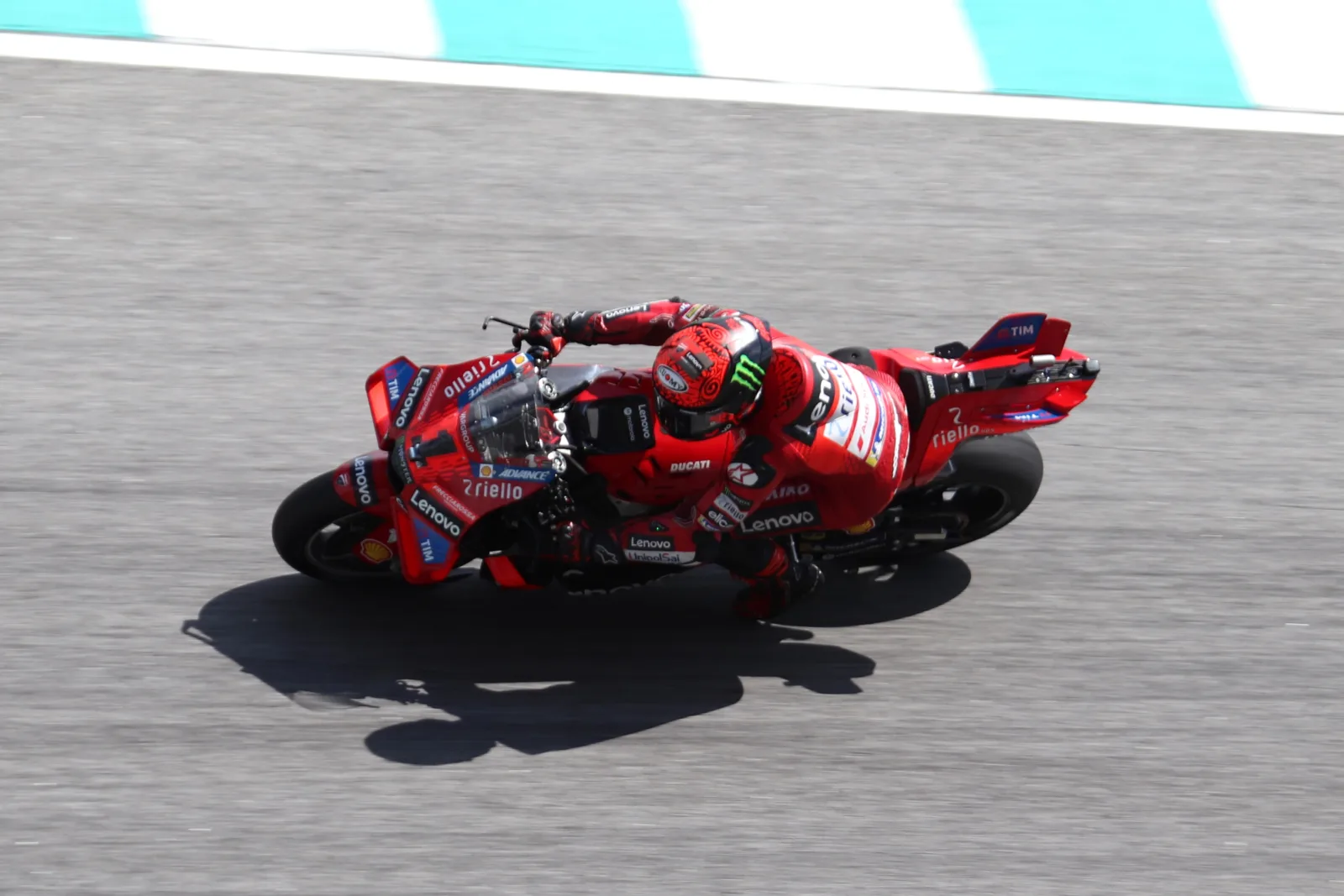
Liauzh / Wikimedia Commons, CC BY-SA 4.0 (https://creativecommons.org/licenses/by-sa/4.0/). Sepang, 1 November 2024.
Motorsport usually sells progress through bigger numbers: more power, higher speeds, faster laps. MotoGP’s next major technical reset asks a more interesting question. Could reducing some of those numbers make the racing better?
The rules announced for 2027 reduce engine capacity from 1,000cc to 850cc, curb aerodynamics and remove ride-height and holeshot devices. MotoGP’s announcement of the new regulations presented a broad change to the machines rather than a minor adjustment to an existing formula.
The attraction for spectators is obvious. A motorcycle championship should reward the rider’s ability to brake, turn, accelerate and improvise around an opponent. When technical development makes a bike faster in isolation, it does not automatically make two bikes more entertaining to watch together.
Aerodynamics illustrates the tension. Winglets help control the motorcycle, but their influence is part of a wider debate about how bikes behave when following each other. MotoGP’s 2026 explanation of winglets sets out their purpose and the coming restrictions. The 2027 change reduces the scope of aerodynamic development; it does not mean every wing disappears.
Removing devices that alter ride height also changes the rider’s task. Manufacturers will have to recover performance within a different set of constraints, while riders must adapt their technique to machines that react differently. The sport is not abolishing engineering. It is deciding which engineering problems teams should solve.
Early rider impressions are encouraging, but they are not a verdict. In an official interview about the 850cc era, Aleix Espargaró expressed optimism about the prospect of closer battles. Such feedback is valuable because riders can describe sensations a lap time cannot capture.
Testing, however, is not a crowded race. An enjoyable prototype still has to demonstrate that it allows sustained pursuit, varied lines and realistic overtaking opportunities. A lower headline speed will mean little to fans if the order remains equally difficult to change.
There is a competitive risk as well. A reset can shuffle the hierarchy, but it can also reward whichever manufacturer understands the new requirements first. A technical change does not guarantee that everybody arrives equally prepared.
The sensible standard for judging 2027 is therefore broader than whether a circuit record survives. Watch how long riders can remain close, whether they have more than one viable way to attack and how often a duel lasts beyond a single braking manoeuvre.
MotoGP’s gamble is that placing limits on the machine can create more possibilities for the rider. It is a persuasive ambition. The proof will come when the lights go out and the new motorcycles have to share the same piece of asphalt.
Andrea Michelini
Writer
 Rossi vs Márquez: the greatest debate has no finish line

No comments yet — be the first.